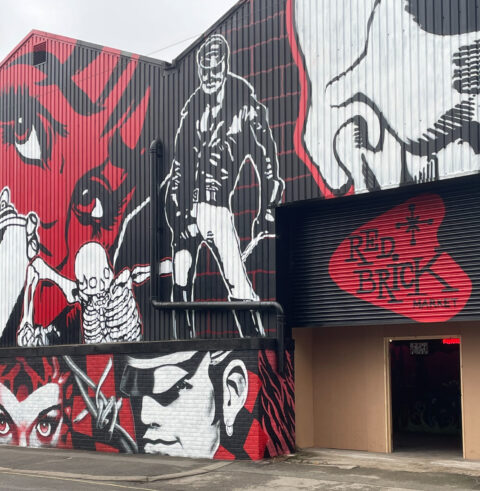
Now that we’ve taken a look into the different markets Brick Lane has to offer, let’s take a look at what you’ll find in and out of the stalls. The Boiler House is located at the Truman Brewery and serves as both the popular Brick Lane food hall and an iconic London historical landmark. By the early 20th century the Brick Market was in poor condition, but it was restored in the 1920s by Norman Isham, an architectural historian and professor who specialized in preserving colonial-era buildings in Rhode Island. The building is now owned by the Newport Historical Society and operated as the Museum of Newport History, where it stands amid modern shopping plazas. Known as the Henry B. Young Building, it was built in 1861 but was heavily altered in the 20th century, including the removal of the top floor, and today it bears little resemblance to the building from the first photo. The Brick Market was the last of his confirmed works, and is shows the influence that English architecture had on his designs.
Brick Market Structure, Competitive Intelligence And Key Winning Strategies
The building, designed by noted 18th-century American architect Peter Harrison and built in the 1760s, is a National Historic Landmark. The largest of these is the popular North American franchise, Bricks & Minifigs (sometimes called “Bricks and mini figures”), which boasts over 100 retail locations. The remainder of the world’s unofficial LEGO stores are either small chains (less than five stores) or independently operated outfits. WILCO works with 3rd parties and resellers directly to collect and aggregate sales figures on the LEGO market and secondhand LEGO economy.
The SPER Market Research report seeks to give market dynamics, demand, and supply forecasts for the years up to 2030. Whether in gardens or parks, or even in urbanwalkways, bricks provide a hardwearing surface for pedestrian traffic. They bring outdoor spaces into their own with a touch of elegance to the visible surroundings, thereby wedding utility with beauty.
The Brick Market
Clay bricks, sand lime bricks, fly-ash clay bricks, and many such specialized variants fulfill various conditions of the environment and architectural needs. The global brick market remains an integral part within the structure of the construction industry, providing sustainable solutions that blend both tradition and innovation. Of course, that evolution marks all the more the resilience and adaptability true to this market and its relevance in a very dynamic and increasingly eco-conscious world. The brick market is an important sub-sector in the construction industry bearing important roles in fulfilling infrastructure needs throughout the world. From time immemorial, the bricks having strength, flexibility, availability and cost advantages have remained the most popular construction materials available in the market inspite of the availability of superior construction materials these days.
What To Expect At Brick Lane Market?
Asia-Pacific generated 48% of 2024 global sales and is projected to grow 3.44% annually to 2030, buoyed by record urban migration and transport megaprojects. China and India spearhead masonry consumption as public-sector housing pushes converge with subway, airport, and industrial-park builds. Producers deploy tunnel kilns with waste-heat recovery to meet provincial emission caps and reduce coal dependence, safeguarding supply resiliency during demand spikes. Dealer and retail outlets captured 60% of brick market revenue in 2024 thanks to entrenched suburban dealer networks and DIY refurbishment demand. Yet direct project-based distribution is the fastest lane, expanding 3.70% annually as contractors integrate procurement with scheduling software.
Clay Brick Market – Global Industry Size, Share, Trends, Opportunity, And Forecast, 2020-2030F
The sudden rise in CAGR is attributable to the market’s increase and demand returning to pre pandemic levels once the pandemic is over. The independent indoor market is seeing more and more small businesses taking residence at the site, including clothes companies such as Cow, Dark Bull Vintage and Rift Retro. For all your accessory needs there’s Selected Steeze offering hand-picked vintage pieces and On The Sunshine selling snazzy handmade jewellery. Red Brick Market acts as a department store alternative retail site where stallholders needn’t have to be present at their stall. With a central payment desk and staff employed by Red Brick Market on the floor, stallholders are able to come and go as they please and shoppers just pay on their way out whether they are there or not.
What Is The Current Market Situation In The Bricks Market?
Bricks add charm and a sense of uniqueness to commercial buildings as they do not dent and rot, which enhances their adoption in the construction of commercial buildings. The growing call for in the residential and infrastructure sectors is a key driving force of increase within the concrete block and brick market. In residential production, the surge is fueled by way of urbanization and the need for less costly housing, especially in emerging economies like India and China. Government projects assisting housing infrastructure and growing consumer desire for single-own family houses in addition propel this demand. In the infrastructure sector, huge-scale initiatives such as airports, roads, and public utilities are riding the want for durable and price-powerful building materials.

It was still in use as city hall when the first photo was taken in 1890, and it would remain so for another decade, until the current city hall was completed in 1900. The brick industry has always stood at par in the global market today as a cornerstone in construction, poised with durability and versatility across any building project. Some of these important movers and shakers arebusinesses like Acme Brick Company, Bigbloc Construction Ltd., and Wienerberger AG. These main application areas for bricks are complemented by several other small-scoped usages in various industries. Their adaptability runs from industrial applications—kiln linings—to all sorts of decorative elements within interior design.
However, the development trajectory of this industry might potentially stall over the next years due to a new coronavirus epidemic that is affecting key building centres like India. The expansion of infrastructure and building activities has propelled the brick sector in India to see significant growth during the past few years. The possibilities for the expansion of the blocks and bricks business have also been boosted by India’s increasing population, increased per capita income, enhanced economic growth, industrialisation, and quickening urbanisation.
Museum Of Newport History At Brick Market
- It also evaluates the impact of financial and strategic perspectives on the Concrete Block and Brick Market growth.
- By integrating current technologies and addressing evolving market needs, those improvements force expanded adoption and stimulate a boom inside the market.
- With a central payment desk and staff employed by Red Brick Market on the floor, stallholders are able to come and go as they please and shoppers just pay on their way out whether they are there or not.
- In terms of application, the global market is categorized into residential buildings, commercial buildings, infrastructure, paths, parterre, and landscaping.
- Improvements made to the different methods and materials for producing bricks widen their potential application area even further, so as to remain relevant under changing construction scenarios.
- Furthermore, supply chain problems have been overcome since global commerce has partially resumed.
Moreover, supportive government initiatives, coupled with a rising population, contribute to sustained growth. The construction boom in countries such as China and India further solidifies Asia-Pacific as a key market for bricks, with the potential for continued expansion in the future. The market is highly competitive, driven by a combination of established players, regional manufacturers, and innovative startups. The focus on sustainability and eco-friendly construction practices has spurred innovation in the market. Startups and smaller manufacturers have entered the market with a focus on producing environmentally responsible bricks.
In the case of this market segment, the needs of landscape architects and committee works will prove to be a driver of brick demand. Generally, modular bricks are used, which are a little larger than the standard ones, for ease in construction. Modular bricks are heavily used in extensive work where time and cost-to-benefit ratios matter the most.

This brick industry is embedded with all sorts of competitors, continuously showcasing milestones of companies that have other kinds of strengths and bring forth different innovations. From Bigbloc Construction Ltd. in North America to the Brampton Brick in Europe, all these substantial contributors have been major components in the technological advancement and market expansion alike. The report on the market includes an assessment of the market, trends, segments, and regional markets.
Global Brick Market Is Estimated To Grow With A CAGR Of 31% From 2024 To 2031
Other performers, unrelated to Harper and Powell, also used the space, but not on a regular basis. Bricks are fundamental structural components usually created from clay, shale or concrete and mortar is a binding material normally from a cement composition. They used in structures to develop walls, pavements and various other constructions and is in the form of rectangular blocks. They come in different sizes and are available in different colours and textures, which make them suitable for roofing of a variety of building designs. Understanding the properties of bricks as a construction material gives them a high rating as a construction material to this day. Europe trails in growth but leads innovation as the CBAM exposes carbon-intensive imports and rewards local low-carbon pioneers.
Data centers classified as critical infrastructure in the United States also elevate orders for fire-rated brick envelopes. Building applications accounted for 60% of brick market share in 2024, reflecting masonry’s historic role in structural walls and facades. The brick market size for path and paving solutions, however, is expanding at a 3.14% CAGR as households invest in outdoor upgrades and municipalities retrofit sidewalks to endure heavier pedestrian flows.