
The exact mechanisms are not completely understood, although there is evidence of direct toxicity to endothelial cells, with subsequent complement activation 41,44. Patients present systemic features of TMA, in association with AKI 42,45,46. At least one case reported successful use of eculizumab, but the patient also presented a complement protein mutation 41.
- It is important to exclude any other diagnosis before attributing TMA to a drug.
- CP is responsible for statistical analyses and contributed to data extraction.
- Immune checkpoint inhibitors (CPIs) are part of this class of drugs, consisting of monoclonal antibodies that target inhibitory receptors expressed on T cells 85.
- We report on two patients with chemotherapy-induced TMA who were successfully treated with a short course of the terminal complement inhibitor eculizumab.
Laboratory results revealed decreasing hemoglobin (8.4 g/dl from 12 g/dl) and platelet count (144×1000/µl). Lactate dehydrogenase (705 U/L), reticulocyte count (3.11%), and fibrinogen (492 mg/dl) were elevated. Gemcitabine was discontinued, and the patient underwent a kidney biopsy.
ETable 3 ADAMTS13 Activity
There is common agreement on avoiding toxic serum concentration of calcineurin inhibitors (CNIs) 8 and tapering their dosage as soon as the laboratory evidence of endothelial damage becomes available. Much less agreement on CNI withdrawal exists when a formal diagnosis of TA-TMA is posed because of the risk of inducing or exacerbating acute GvHD, a known trigger of endothelial damage and TA-TMA 9,10,11. Recently, evidence of a central role of complement has emerged, with involvement of both classic and alternative pathways (Fig. 1) 100, 101, 102, 103, 104, 105, 106, 107, 108, 109. In fact, some of the described risk factors also have the ability to activate complement pathways, including high doses of CNI/mTORI, viral infections and GVHD 102,110. Bleomycin, an antibiotic that inhibits DNA synthesis, is frequently used in combination with platins in several cancers 42,46. Endothelial damage is a known effect of bleomycin, with case reports describing Raynaud’s phenomenon, digital infarcts and pulmonary toxicity.
Drug-induced Hemolytic Uremic Syndrome
Proteinuria is described as an indirect sign of the anticancer effect of this drug. Kidney-limited TMA (type 2) is the main phenotype reported, with only mild anemia or thrombocytopenia 6,63,64. Drug withdrawal and supportive care are the only therapeutic approaches available. The response to plasmapheresis is poor, and red blood cells (RBC) transfusions could exacerbate TMA 21,23.
ETable 1 Differential Diagnoses Of Thrombotic Microangiopathy
A concern that liver allograft may not initially produce sufficient amounts of the regulatory factors may be circumvented by plasmapheresis in the perioperative time to restore levels of the complement proteins. Three reports have described DITMA caused by pentostatin, a purine analog used in lymphoproliferative diseases (29). Docetaxel and vincristine have also been reported to induce TMA (30, 31). Oxaliplatin has been implicated as a cause of DITMA in a review by Al-Nouri et al. (2), although the authors of the original report described gemcitabine as the causative factor (32). Renal-limited TMA has been reported in three patients treated with pegylated liposomal doxorubicin (33) and in one patient receiving treatment with a short interfering RNA targeted against Myc (DCR-MYC) (5). These data suggest a variable complement involvement, a likely different susceptibility to anti-complementary drugs and an heterogeneity of the DITMA mechanisms.
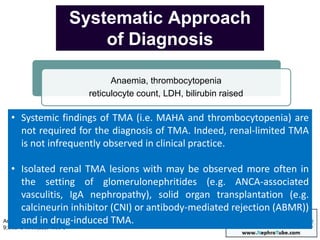
Interestingly, there is a long history of trades between these teams, with multiple players having played for both sides. Indeed, the presence of a complement mutation may not become significant without the stress of a clinical trigger. An otherwise strong thrombotic thrombocytopenic purpura (TTP) team missed the cut for the NephMadness bracket because of its underwhelming effect on the kidneys. The table presents the number of patients reported with a definite causal association with TMA for each of the 31 drugs. Given the role played by complement system activation, anti-complement drugs have been proposed as a therapeutic option in DITMA.
Tumor-induced TMA (TiTMA) is a relatively rare paraneoplastic syndrome, with little incidence data. A retrospective French study analysed primary and secondary TMAs, reporting a TiTMA incidence of 19% 139. Most patients had already been diagnosed with cancer, although it can occasionally be a presenting sign of malignancy 89,140. Unlike other paraneoplastic syndromes, there is a high number of cases of TiTMA that occur with cancer recurrence, probably due to changes in tumor cells properties as a consequence of chemotherapy 141. The difficulty of histologic diagnosis led to the development of non-invasive clinical criteria for HSCT-TMA diagnosis.
Congenital Thrombotic Thrombocytopenic Purpura (Upshaw–Schulman Syndrome)

Recognizing thrombotic microangiopathy and initiating plasmapheresis within 4 to 8 hours is essential for successful therapy (recommendation grade 1 B) (5). Plasmapheresis helps to reduce mortality of thrombotic thrombocytopenic purpura (TTP) to approximately 10–20% (3, e1). A diagnostic and therapeutic algorithm, as well as a classification of thrombotic microangiopathies, are shown in Figure 1, Table 1, eTable 2, and eTable 3, and the relevant differential diagnoses, in eTable 1. The establishment of a nationwide disease registry in Germany with a biobank would now be desirable. HELLP is a more severe form of the disease spectrum, which can lead to a glomerular endotheliosis.
CTTP Treatment
There is known endothelial dysfunction thought to be due to greater circulating levels of the soluble form of the vascular endothelial growth factor receptor (sFlt‐1), syncytiotrophoblast‐derived antiangiogenic factors and soluble endoglin. During the last decade, laboratory criteria have been added to support the causal relationship between a drug and TMA (2). Some examples of drugs in which antibody mediated DITMA has been confirmed with identification of drug-dependent antibodies to platelets or other cells as the pathophysiologic mechanism of TMA are quinine, oxaliplatin, and vancomycin (12). On the other hand, the dose-dependent and cumulative toxicity model seems to fit for opana’s abuse, bevacizumab, levofloxacin, alemtuzumab, and interferon’s cases of DITMA (9, 13–15).

Pregnancy
Drug-induced TMA (DiTMA) can be either dose- and time-dependent or non-dose-related (idiosyncratic reactions). The latter situation should be suspected when there is an abrupt onset of symptoms that recur with drug administration, and it is mostly caused by drug-dependent antibodies that react with platelets and endothelial cells. Dose/time-dependent situations are usually related to a slowly progressive kidney injury in consequence of TMA 1,6. Mechanisms that lead to complement activation or ADAMTS13 deficiency have also been suggested 6,14,15.
The latter inhibits the vWF-cleaving protease and leads to uncontrolled thrombosis of small and micro blood vessels in almost all organs. This results in the clinical picture of an immune-mediated, acquired thrombotic thrombocytopenic purpura (aTTP) (figure 2). In contrast, in hemolytic uremic syndrome (HUS), thrombus formation almost always occurs in the kidneys, although it may affect other organs in some patients. Further, in HUS, endothelial damage with complement activation and increased vWF release results in vascular occlusion. Chemotherapy offers curative treatment for early stage cancer and palliation for late-stage cancer but may have off-target effects including kidney toxicity.
How We Reviewed This Article:
Complement-mediated TMA (CM-TMA) results from dysregulation of the complement system, mainly the alternative pathway, which then leads to inappropriate activation of the terminal pathway. In Primary TMA, alternative pathway dysregulation can be genetic (due to mutations in complement proteins), acquired (due to autoantibodies against complement proteins), or idiopathic. The alternative pathway was an MVP in NephMadness 2019 for the Complement Region.
Important risk factors for TMA relapses constitute an identified genetic mutation, former TMA episodes, or concomitant permanent or likely recurrent complement-activating condition. Close monitoring of renal function and hematological parameters after eculizumab withdrawal is mandatory; however, there are no evidence-based data about the reliability of a specific parameter and the optimal frequency of testing 33. These include the retrospective design, the limited number of patients treated, and their highly heterogeneous clinical presentation including the presence of both pediatric and adult cases.